Rolling Out Corporate Fitness in Greenville
A downtown Greenville office can start corporate fitness with three or four people, a nearby gym, and a dedicated time.
by: Shannon Kolb
Most offices never start corporate fitness because it feels like a big project. And a big project feels like a big commitment.
You don't need any of that.
This is the fourth post in our series on corporate fitness. The first one covered productivity — more energy after lunch, fewer desk-life aches, better sleep. The second covered morale — what happens to a team when they train together. The third covered why gym benefits fail — money for a gym is not the same as people showing up. This one is the how. How a downtown Greenville company starts, step by step, without making it a project.
Start With Three or Four People
Do not kick this off with the whole company. That is how it becomes a project.
Pick three or four people who will actually go. People who already want to move. People who will show up on a Tuesday when the inbox is loud.
A small group is easier to book. Easier to coach. Easier to keep. When they come back to the office with more energy, coworkers notice. That is how it spreads. Not from a poster in the break room.
Pick a Gym That Fits a Real Lunch Hour
If the gym is a 20-minute drive, lunch is dead. After work is a fight with traffic. The habit dies before it starts.
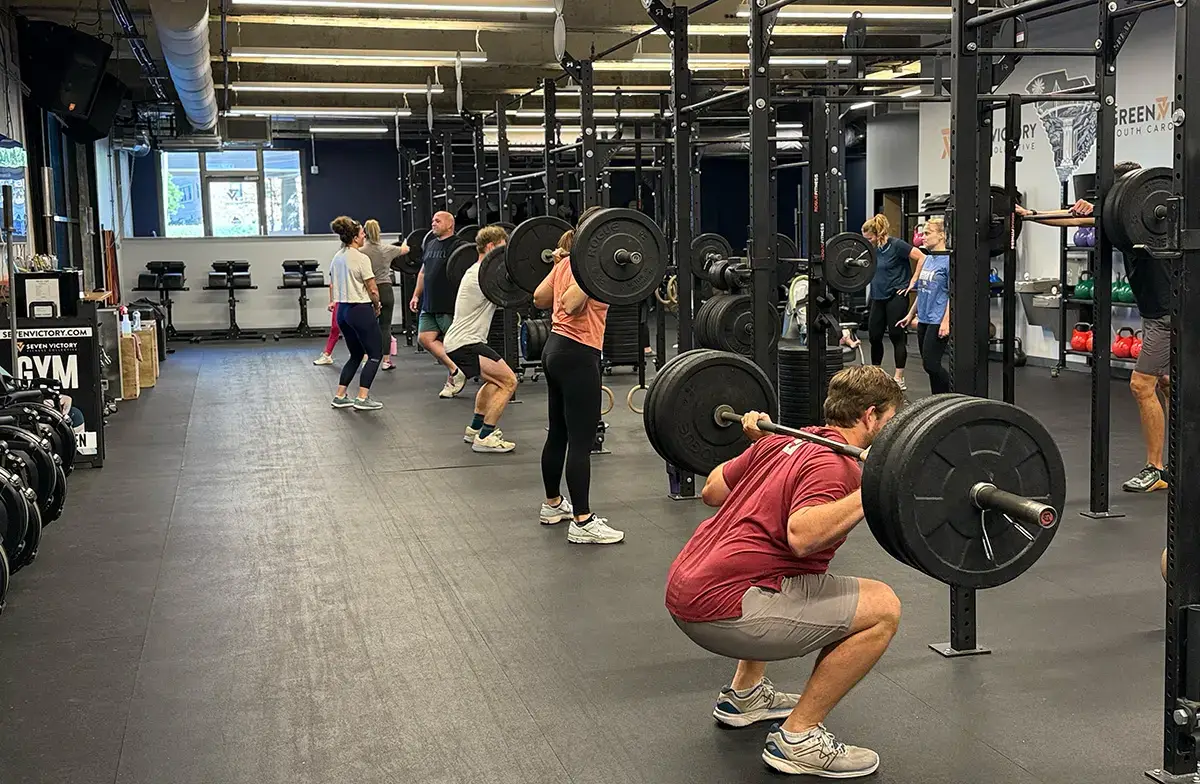
Seven Victory is at 301 N Main Street, Suite 200, across from the Hyatt. Indoor garage parking means nobody circles the block. Locker rooms, showers, and towels mean people walk back into a 1 p.m. meeting looking like they work there.
Find a gym close enough that time stops being the excuse.
The training has to fit a workday too. Personal training for people who want a plan built around their body and calendar. Small group classes where a coach watches form and knows names. Golf fitness, stretch therapy, nutrition coaching, and an infrared sauna mean one place can fit the golfer and the person who has not trained in years.
Start With a Punch Card, Not a Company Plan
You do not need a 40-person membership on day one.
We size corporate memberships to the team that will actually use them. A business punch card is the easy first step. A few people try classes. You see who comes back. Then you grow it.
That is the opposite of a gym benefit that sits unused. You are buying sessions people will use, not access they forget.
Get One Manager Who Will Go
Skip the wellness committee. A committee writes rules. A manager who trains sets the tone.
You need one person with a title who will put it on their calendar and keep the slot. Not a speech. Not a memo. Just show up.
When the boss is in class, the team feels permission. When the boss only talks about wellness, the team hears optional homework.
Protect a Recurring Slot
A one-off class is a field trip. A Tuesday at noon is a habit.
Pick a time that already fits the office. Lunch is the usual one downtown. Put it on the calendar every week. Do not keep moving it for "just this once." Just this once is how the habit dies.
Keep it optional. Nobody should feel watched. Low friction means the gym is close, parking is easy, showers are there, and signing up is simple. If people need a form, a code, and a 20-minute walk, they will not keep going.
Measure Who Keeps Showing Up
Do not measure this by the launch email. Do not measure it by who signed up in week one.
Measure who is still there in week six.
Our corporate page carries the industry's favorite stat — that 89% of employees with wellness programs are highly engaged and happy at work. Treat that as the sales pitch. The proof in an office is simpler. People keep going, or they don't.
The version we can stand behind is the one we hear from teams that train here:
"Several of our employees regularly attend classes at Seven Victory. I have seen an energy ignite in the team and an enhanced commitment to performing at a high-level both personally and professionally."
— Chris Harrison, President, Dunean Capital Management
That did not come from a kickoff meeting. It came from people who kept showing up.
You Can Start This Week
Three or four people. A gym close enough for lunch. A punch card. One manager on the calendar. A time that does not keep getting moved.
That is the whole rollout.
If you want help sizing it, ask about corporate memberships or book a free intro and come see the space. This series can keep going from here — lunch-hour training for downtown teams, and how managers who sit all day can start without blowing up the calendar.