GLP-1 and Strength Training to Keep Muscle
GLP-1 drugs can drive fat loss and some lean mass with it. Strength training in Greenville protects muscle.
by: Seven Victory Team
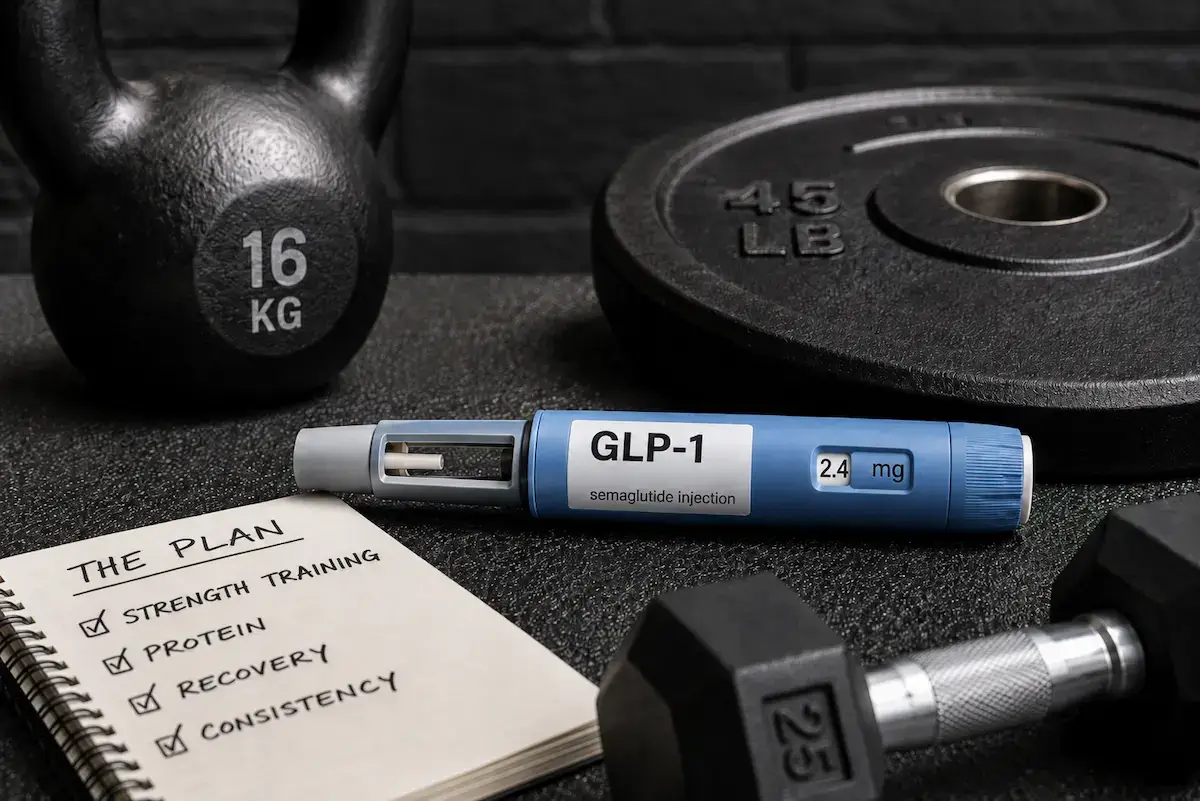
If you are on a GLP-1 medication — Ozempic, Wegovy, Mounjaro, Zepbound, or another incretin drug — the scale may already be moving. That is the point.
It is also not the whole story.
A big drop on the scale can include fat, water, and lean tissue. Lean tissue is not just "muscle" in the gym sense. It includes skeletal muscle, organs, and other fat-free tissue. Lose too much of the muscle you actually use, and you can end up lighter but softer, weaker, and easier to re-gain fat later.
This is not an argument against GLP-1s. Used under medical care, they are a major advance for a lot of people. It is an argument for pairing the medication with strength training so the weight you lose is the kind you want to lose.
This article is for education, not medical advice. Decisions about medications, protein targets, and exercise should be made with your clinician.
What the Research Actually Shows
Fat falls hard. Lean mass falls too.
In the STEP 1 body-composition substudy of once-weekly semaglutide 2.4 mg, adults with overweight or obesity lost substantial fat — about 19.3% of total fat mass over 68 weeks on DEXA — while total lean body mass fell about 9.7%. Because fat fell faster, lean mass as a share of total body weight actually rose about 3 percentage points. (Wilding et al., Journal of the Endocrine Society / STEP 1 DEXA analysis)
That pattern shows up again in broader reviews: absolute lean mass often declines, even while the body-composition ratio improves because fat loss is larger.
A 2026 systematic review and meta-analysis of randomized trials using obesity-dose GLP-1 receptor agonists found a combined absolute lean-mass reduction of about 1.74 kg, with a larger absolute lean-mass signal in the semaglutide data they pooled. The same paper still concluded that lean mass as a proportion of total weight can improve — and that drug treatment should be accompanied by nutrition and exercise to preserve muscle. (Laverde et al., International Journal of Obesity, 2026)
Other synthesis work puts lean-tissue loss in a familiar range for large weight-loss interventions: often roughly a quarter to around 40%+ of total weight lost, depending on the drug, the dose, the person, and whether training and protein are in the plan. That is not unique to GLP-1s. It is what happens when calories drop fast without a plan to defend muscle.
The scale cannot tell you what you lost
Two people can both lose 30 pounds. One kept most of their strength and muscle. One did not. The bathroom scale will not show which.
That is why coaches and clinicians care about how you feel and function: stairs, grocery bags, workouts, energy at 3 p.m. Muscle is metabolic tissue. It helps you stay capable while the medication turns down appetite.
Why Strength Training Is Not Optional on a GLP-1
Cardio is great for your heart and for burning calories. It is not the main signal that tells your body to keep muscle when food intake drops.
Resistance training is.
Across obesity and weight-loss research, progressive strength work is one of the most reliable ways to blunt lean-mass loss during calorie restriction. International exercise and obesity organizations have also been clear in the pharmacotherapy era: structured exercise — especially progressive resistance training — belongs in the care plan if the goals include muscle, strength, and function, not only a smaller number on the scale. (Joint statement: Exercise and Physical Activity in the Era of Obesity Pharmacotherapy)
Practical targets that show up again and again in clinical reviews:
- Strength train major muscle groups about 2–3 days per week (the Physical Activity Guidelines for Americans call for muscle-strengthening work at least twice weekly).
- Prioritize progressive overload — gradually harder over time, not the same light circuit forever.
- Eat enough protein — commonly discussed targets during weight loss sit around 1.2–1.6 g per kg of body weight per day, individualized with your clinician or dietitian, especially when appetite is suppressed. (Review of strategies to minimize muscle loss on incretin drugs)
If you only walk more and eat less, you may still lose muscle you would rather keep. If you lift with a plan and hit protein, you give your body a reason to hold onto it.
What This Looks Like at Seven Victory
You do not need a bodybuilding program. You need coached, practical strength work that fits a real schedule and a changing appetite.
At Seven Victory Fitness Collective in downtown Greenville, that usually means:
- Personal training built around your joints, your dose schedule, and how little you feel like eating that week
- Group classes with coaches watching form, not a packed floor where you guess
- Nutrition coaching when protein goals collide with GLP-1 appetite suppression
- Recovery tools (including our infrared sauna) for the days the medication and the training both take a toll
We train people who are already on medication and people who are about to start. The goal is the same: lose fat, keep as much useful muscle and strength as you can, and leave the gym more capable than when you walked in.
Locker rooms and showers are part of the membership, so a lunch-hour session can still fit a workday.
A Simple Plan If You Are Starting (or Already On) a GLP-1
- Talk to your prescribing clinician before changing training or protein targets, especially if you have joint issues, heart disease, or very low appetite.
- Get under a barbell, kettlebell, or machine with a coach at least twice a week. Legs, hips, back, chest, shoulders, arms — all of it.
- Treat protein like a non-negotiable. When food volume drops, protein quality and timing matter more.
- Judge progress by more than weight. How do stairs feel? How much can you lift? How is your energy?
- Do not wait until you have already lost 40 pounds to start training. Muscle is easier to keep than to rebuild.
The Bottom Line
GLP-1 medications can change your weight. Strength training helps decide what that weight change is made of.
The research is consistent on the basics: expect some lean-mass decline with large weight loss, expect fat loss to lead, and expect resistance training plus adequate protein to be the main tools for protecting muscle and function.
If you are in Greenville and you want a place that coaches that plan — not a warehouse of machines — book a free intro or start with personal training. Bring your questions about training on a GLP-1. We will build the session around them.
Sources
- Wilding JPH et al. Impact of Semaglutide on Body Composition… STEP 1 exploratory DEXA analysis. Journal of the Endocrine Society (2021). PMC8089287
- Laverde LP et al. Effect of GLP-1 receptor agonists at doses for obesity management on muscle health: systematic review and meta-analysis of RCTs. International Journal of Obesity (2026). DOI: 10.1038/s41366-026-02118-y
- Wilding JPH et al. Once-Weekly Semaglutide in Adults with Overweight or Obesity (STEP 1). New England Journal of Medicine (2021). NEJM
- International joint statement: Exercise and Physical Activity in the Era of Obesity Pharmacotherapy (2026). PDF
- Clinical review summarizing resistance training and protein strategies during incretin therapy. Strategies for minimizing muscle loss…